
Cherokee County Court Records After a Jail Arrest
The trail to court records after a jail arrest in Cherokee County usually starts at the Cherokee County Detention Center, where the sheriff's roster records the booking number, booking date, arresting agency, listed charges, and any bond information available to detention staff. The sheriff's office, led by Sheriff Jeff Shaver, publishes the roster as a custody source rather than a final court disposition. The public profile note is important because it warns that charges and bail amounts can change after court appearances and may not be current. That is the practical reason to treat the roster as a custody and booking source, then verify the formal case through the Cherokee County Circuit Clerk or Alabama's court-record system.
The booking side and the court side answer different questions. For current custody, booking dates, arresting agency, and jail profile fields, use jail inmate records. For booking photos and the current and 48-hour release roster display, use jail mugshots. For court charges after arrest, use the court record maintained by the Circuit Clerk and the Alabama Unified Judicial System. The district attorney may file charges that use different wording from the jail roster, and a grand jury indictment can supersede an earlier complaint path.
How to Find Cherokee County Court Records After an Arrest
The Cherokee County Circuit Clerk is the official keeper of court records after an arrest for District and Circuit Court proceedings. The clerk's office is at the Cherokee County Courthouse, 373 East Main Street, Suite 102, Centre, AL 35960, phone (256) 927-3637. Posted hours are 8:00 a.m. to 4:00 p.m., Monday through Friday, with the office closed from 12:00 p.m. to 1:00 p.m. Clerk Dwayne Amos's office lists Criminal, Traffic, Juvenile, Warrants, Civil, Domestic, and Child Support divisions and points users to Alabama's Just One Look service for trial court records.
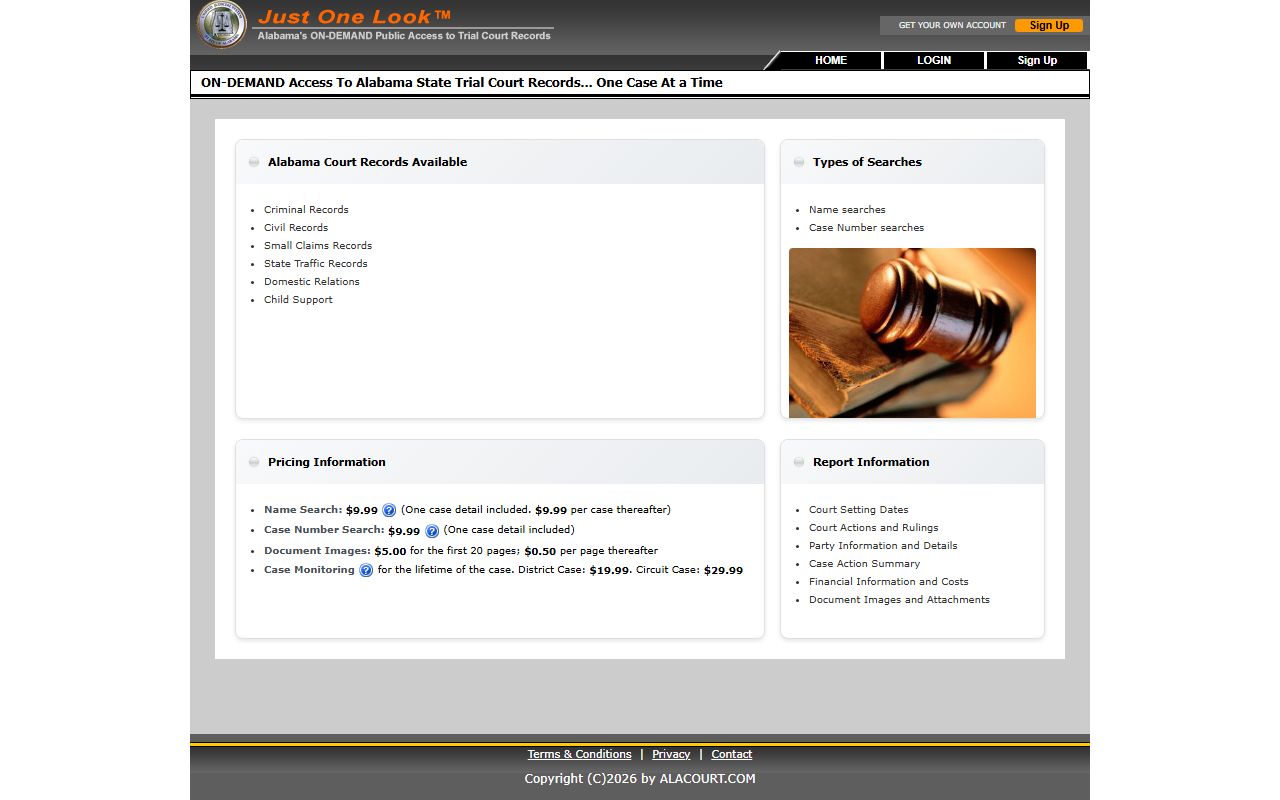
The Alacourt ACCESS / Just One Look portal is the documented statewide search path for Alabama trial court records. Its public landing page lists criminal, civil, small claims, state traffic, domestic relations, and child support coverage. It offers name searches and case-number searches, but the research did not find a free Cherokee County public criminal docket search by defendant name. Paid pricing observed in May 2026 was $9.99 for a name search or case-number search, $5.00 for the first 20 pages of document images, $0.50 for each page after that, and separate case-monitoring options for district and circuit cases.
The official Just One Look landing page shows the search types and pricing used for Alabama trial court record access.
Use that portal for court-file information, not as a substitute for the sheriff's roster when the immediate question is whether someone is physically in the Cherokee County Detention Center.
| Search Field or Option | How It Applies to Cherokee County Charges |
|---|---|
| Name Search | Paid search path for trial-court records when the defendant's name is known; one case detail was included in the listed May 2026 pricing. |
| Case Number Search | Paid search path when a citation, clerk record, detention-staff note, or prior court paper gives the case number. |
| Login / Sign Up | Required for full portal use beyond the public pricing and service landing page. |
| Document Images | Optional paid document access for copies when images are available through the portal. |
| Case Monitoring | Optional paid monitoring for future district or circuit case changes. |
- Start with the sheriff's roster to capture the exact name spelling, booking date, arresting agency, booking number, and listed booking charges.
- Search Alacourt ACCESS by defendant name or case number if a case number is available from the roster note, detention staff, a citation, or prior court paperwork.
- Open the case detail and read the charge list, court action summary, settings, financial history, party information, and case status.
- Compare each court charge to the jail roster charge because the prosecutor may amend, reduce, add, dismiss, or supersede charges after the booking event.
- If the online system does not show the local record, contact the Circuit Clerk or use the Cherokee County court record request form for Circuit and District Court records.
The Cherokee County court record request form asks for the request date, specific information requested, name, date of birth or identifying information, known case numbers, certification choice, requester address, phone number, and email. The form says to allow two weeks, include a $5.00 deposit, and use a cashier's check or money order payable to Cherokee County Circuit Clerk. Personal checks are not accepted. Search fees are $10.00 for computerized records, $20.00 for paper records, and $25.00 for archived or microfilmed records. The search fee applies even if no record is found, and the clerk can supply Cherokee County Circuit and District Court records only.
How Charges Get Filed After an Arrest: Complaint, Information, and Indictment
A jail arrest can begin with an officer's arrest charge, an arrest warrant, a failure-to-appear or failure-to-pay matter, a court order, or a hold for another agency. After booking, the formal criminal case depends on court filings and prosecution decisions. Cherokee County is in Alabama's Ninth Judicial Circuit, and the district attorney prosecutes criminal cases for the State. The DA's formal filing may use language that differs from the roster charge, and the sheriff's local abbreviation list includes GJI for Grand Jury Indictment.
| Complaint | Information | Indictment | |
|---|---|---|---|
| Filed By | Law enforcement or prosecutor, depending on the charge path | Prosecutor | Grand jury |
| Common For | Initial charges, misdemeanors, and felony complaint paths | Prosecutor-filed charges where allowed by procedure | Felonies or cases presented to a grand jury |
| How It Relates to Booking | May match the jail charge or begin with different wording | May refine or replace the arrest wording | May supersede an earlier complaint or roster description |
| Where to Verify | Circuit Clerk / Alacourt case record | Circuit Clerk / Alacourt case record | Circuit Clerk / Alacourt case record |
Charge Status and What It Means
Charge status can change as a Cherokee County case moves from booking to initial appearance, preliminary hearing, grand jury action, plea, trial, dismissal, or payment/fine compliance. Alabama Rule of Criminal Procedure 4.3 sets timing for probable-cause review after warrantless arrests and judicial appearance after warrant arrests when release conditions are not met. Rule 4.4 covers the initial appearance, including informing the defendant of the charges, advising about counsel and silence, and determining release conditions. For felony complaints, Rule 5.1 gives the defendant 30 days after arrest to demand a preliminary hearing.
| Status | What It Means |
|---|---|
| Pending | The charge has not reached a final court disposition. |
| Amended / Reduced | The prosecutor or court changed the charge wording or accepted a lesser offense. |
| Dismissed | The charge ended by court or prosecutor action and did not result in a conviction on that charge. |
| Nolle Prosequi | The prosecutor declined to continue with that charge, often shortened to nol-pros. |
| Guilty Plea / Conviction | The case reached an adjudicated outcome by plea, verdict, or other conviction entry. |
| Failure to Appear / Failure to Pay | A missed court event or unpaid fines/costs may trigger a warrant, booking, or court-order custody. |
Bond and Release After an Arrest
The Cherokee County Detention Center publishes local bond instructions for property, cash, and bonding-company bonds. Alabama Rule of Criminal Procedure 7.2 provides the state release framework for bailable offenses, including personal recognizance or appearance bond unless the court or magistrate finds release will not assure appearance or will pose danger. Local practice matters, though. The jail says all roster entries with a bond amount of zero can be released only by court order from the presiding judge, or when fines are owed, by paying all fines at the Circuit Clerk's Office. This includes Failure to Pay and NWNI cases.
| Bond Type | How It Works in Cherokee County |
|---|---|
| Cash Bond | Paid in full at the Cherokee County Circuit Clerk's Office or through Cash Bond Online by calling 1-888-726-6301 or using cashbondonline.com. |
| Property Bond | Requires two signatures. Each signer must have property equal to the bond amount, and mortgaged property cannot be used. |
| Bonding Company Bond | Posted through a company licensed in Cherokee County. The sheriff lists Regional Bail Bonds, Rush Bail Bonds, and Connies Bail Bonding. |
| PR / Own Recognizance | A court-controlled release option under Alabama rules when the judge or magistrate allows release without a paid bond. |
| No-Bond or Zero-Bond Hold | Release requires a presiding judge's court order or qualifying fine payment through the Circuit Clerk, and another agency hold can still prevent release. |
Bond may be posted any day except during the sheriff's listed blackout periods of 5:00 a.m. to 7:00 a.m., 11:00 a.m. to 1:00 p.m., and 5:00 p.m. to 7:00 p.m. Because the roster warns that bail may change after court appearances, verify the current amount before paying.
Warrants That Lead to an Arrest
Cherokee County warrant procedure runs through the Circuit Clerk and magistrate system, not a public all-warrants search page. The sheriff FAQ says warrants are issued by the Circuit Clerk. A person seeking a warrant first completes an incident or offense report, then delivers the report to the clerk when obtaining the warrant. If the alleged offense is a felony, an investigator assists with the warrant process. The sheriff's administration page identifies Warrant Clerk Lisa Mobley as responsible for receiving, entering, and maintaining warrants and civil processes from the County Clerk and surrounding areas.
The Cherokee County magistrates and warrants page explains that local warrant jurisdiction includes misdemeanors outside Centre city limits and Cedar Bluff town limits, felonies occurring in Cherokee County, certain traffic offenses, and worthless checks received in Cherokee County.
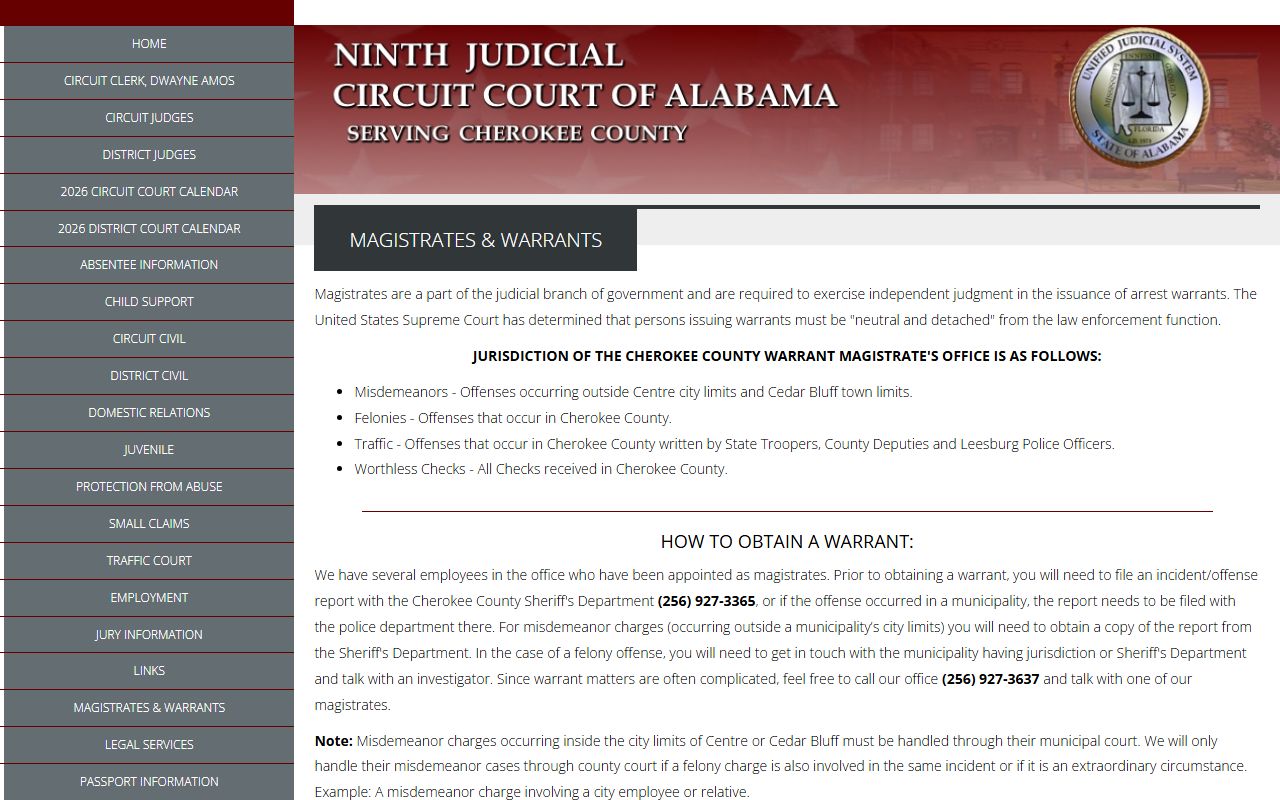
That local warrant page also says an arrest warrant is not a public record until served, which explains why a blank public search does not prove no warrant exists.
No official Cherokee County active-warrant search was found. The sheriff's Most Wanted page is not a complete warrant database. If a person suspects a warrant has been issued against them, the official local instruction is to appear in person at the Cherokee County Sheriff's Department. For a known court case, use the Circuit Clerk, Alacourt, or the court that issued the bench warrant.
Charges vs. Convictions
A charge is an accusation. A conviction is an adjudicated result after a guilty plea, verdict, or other court disposition. Cherokee County roster charges should never be read as convictions because the roster is built from booking data. The court record is the better source for whether the State pursued the charge, whether it was amended or dismissed, and whether a conviction was entered.
| Charge | Conviction | |
|---|---|---|
| Stage | Accusation after arrest, warrant, complaint, court order, or indictment | Final or adjudicated result by plea, verdict, or court entry |
| Proof Standard | Probable cause or charging decision, depending on stage | Beyond a reasonable doubt for trial conviction or accepted plea |
| Where It Appears | Jail roster and court filing | Court disposition and criminal-history record |
| Can Change? | Yes, charges may be amended, reduced, added, dismissed, or indicted | Can be appealed, set aside, pardoned, or affected by later relief only through a legal process |
Sealed vs. Expunged Arrest Records
Alabama public access starts with Code of Alabama Section 36-12-40, which gives citizens the right to inspect and copy public writings except as otherwise provided by statute. Section 41-13-1 defines public records broadly as materials made or received by public officers in the transaction of public business. Access is not unlimited. Juvenile records, sealed or expunged records, confidential medical or mental-health information, sensitive personal information, and some investigation materials may be restricted.
Expungement in Alabama is governed by Title 15, Chapter 27. Code Section 15-27-2 sets the eligibility framework for certain criminal charges and records, and Section 15-27-3 describes petition requirements. ALEA says a petitioner generally needs a certified ALEA criminal history record before filing in the circuit court where the original charge was filed. The ALEA expungement kit treats arrest records, booking or arrest photos, and State Court Information System references as criminal-justice agency records that may be affected by an expungement order.
| Sealed | Expunged | |
|---|---|---|
| Visibility | Public access is restricted by court order or statute. | Eligible records are removed from ordinary public access under the expungement order. |
| Law Enforcement | Access may remain for specific criminal-justice uses. | Law enforcement, prosecutors, forensic agencies, and DHR may retain limited files or logs, but dissemination for non-criminal-justice purposes is restricted after expungement. |
| Eligibility | Depends on the record type, juvenile status, court order, and governing law. | Depends on Alabama Code Title 15, Chapter 27, certified records, disposition, and petition requirements. |
| Practical Route | Ask the court or clerk about the order controlling access. | Use the circuit-court expungement process and ask how the order applies to court, sheriff, and agency records. |
Background Check Considerations
Casual record lookup and regulated background screening are different. A roster page, clerk search, or copy request may help someone understand a Cherokee County arrest-to-court path, but employment, tenant screening, credit, insurance, and other regulated decisions require legally compliant consumer-reporting procedures. Old arrest data can also be incomplete if the court later dismissed, amended, expunged, or sealed the charge.
Important: Cherokee County Inmate Population is not a consumer reporting agency under the FCRA and may not be used for FCRA-covered decisions.
Restricted Court Records After an Arrest in Cherokee County
Not every court record after an arrest is public in the same way. Alabama juvenile court records are restricted under Code Section 12-15-133, and Cherokee County sheriff releases have shown that juvenile name and booking-photo information may be withheld even when a juvenile is charged as an adult. Expunged charges, sealed court files, pending criminal investigations, victim information, medical details, mental-health details, full dates of birth, Social Security numbers, and exact housing or classification information may also be absent from public roster or court displays.
For prosecution records, the Ninth Judicial Circuit District Attorney's Office is not a defendant case-status portal. The Cherokee County DA office is at 100 Main Street, Room 204, Centre, AL 35960, phone (256) 927-5577. District Attorney Summer M. Summerford prosecutes criminal cases for Cherokee and DeKalb Counties, but the court and clerk record remains the better public channel for charge status, disposition, and copies. Victims should keep VINE custody notification separate from DA victim services: VINE reports custody changes, while the DA channel supports prosecution and victim-witness issues.